A chrome beetle, a narrow track and violent percussion turn rhythm inputs into a physical exercise in anticipation.
- Format
- Forward rhythm action
- Pace
- Measured, then punishing
- Session
- 8–30 minutes
- Best for
- Players who anticipate visual rhythm
Rhythm without a note highway
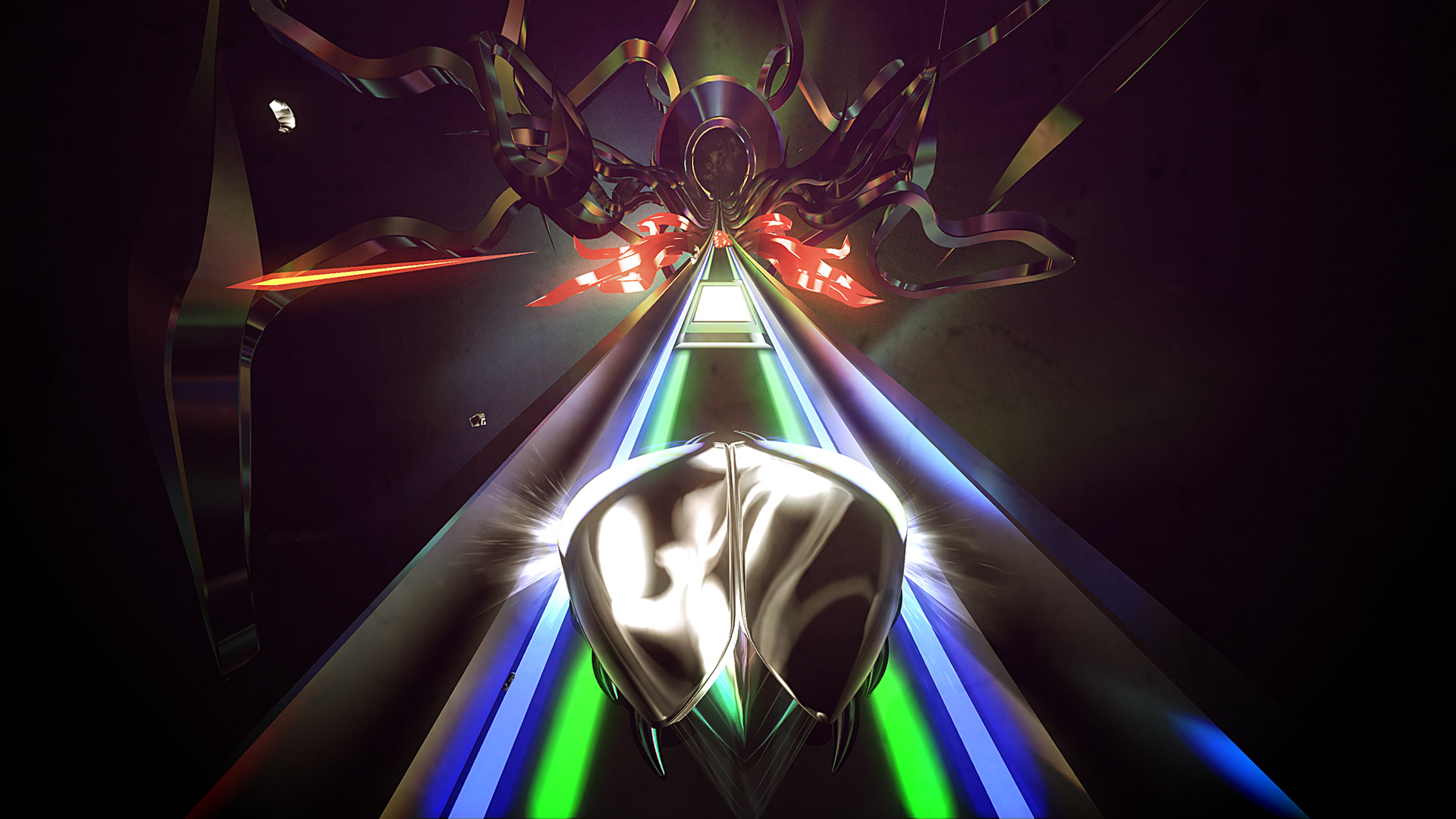
Thumper sends a metallic beetle down a narrow track toward markers, bends and barriers. Inputs are tied to percussion, but the screen does not resemble a conventional column of notes. The player reads objects as physical events approaching through space. A turn must be held, a strike must land and a short sequence may combine both while the track continues to accelerate forward.
This perspective makes timing feel bodily. Missing is not just an abstract rating; the beetle collides, the image tears and the soundtrack loses its intended impact. Successful inputs produce heavy, synchronized hits that seem to travel through the controller. The game earns its “rhythm violence” identity through weight rather than through a huge number of buttons.
Anticipation before reaction
Early stages can be handled by reacting to the nearest marker, but that habit eventually fails. Curves and obstacles must be read as phrases. The player needs to see the second or third object while executing the first, preserving a mental buffer between current input and upcoming shape. Progress comes when vision moves farther down the track.
Audio supports this anticipation with recurring rhythmic structures. A pattern heard once under low pressure may return faster or with an added turn. The soundtrack does not merely decorate the obstacle sequence; it teaches the length and emphasis of each phrase. Headphones reveal small cues, though the low-frequency impact can become tiring during extended sessions.
A compact control vocabulary
Thumper uses few inputs, yet combinations create a wide range of demands. Holding a direction through a curve, striking at contact and managing aerial movement all grow from the same compact vocabulary. The difficulty comes from sequencing and timing rather than remembering a keyboard layout. A failed phrase can usually be described clearly: the hold began late, the strike was rushed or attention remained too close to the beetle.
That clarity makes practice productive. Checkpoints divide long stages into manageable sections, allowing the player to repeat a difficult phrase without replaying an entire level. Performance grades encourage a cleaner return, but simple completion remains meaningful because later sequences require sustained concentration. The design supports both survival and precision without introducing separate rule sets.
Bosses as rhythmic arguments
Boss encounters gather learned phrases into longer exchanges. Successful hits appear to push back against a giant abstract presence, giving the track a visible opponent without changing its fundamental controls. These sequences have a call-and-response quality: survive the approach, strike at the exact opening and watch the environment answer with greater force.
The spectacle is effective because it remains mechanically relevant. Visual expansion marks a new phase, while repeated percussion confirms whether the player is maintaining pressure. A boss can still become hard to read when the background blooms around the track, but recurring marker shapes provide a stable reference. The battle is ultimately against timing, not against a separate combat model.
Pressure, visibility and comfort
The visual world is intentionally hostile: sharp red light, rapid forward motion and enormous forms crowd the horizon. That pressure makes success intense, but it can also cause eye fatigue or motion discomfort. The fixed track offers a reliable center, yet peripheral effects remain active even when the required input is simple.
Players should use shorter sessions, lower volume if needed and take the game’s checkpoint structure as permission to stop. Reduced concentration quickly becomes visible in late inputs. The design is not improved by enduring discomfort. Its power comes from controlled intensity, and that control includes deciding when the sensory load has stopped serving accurate play.
Replay value beyond completion
A first clear often contains defensive timing and broken phrases. Returning for a stronger grade reveals how much rhythmic shape was missed while merely surviving. Because obstacles are authored rather than randomized, practice converts directly into cleaner anticipation. The stage becomes a piece that can be performed, not simply a tunnel that was escaped once.
That authored structure also limits surprise after mastery. Players who need endless procedural variation may stop once grades satisfy them. The replay appeal is closer to revisiting a difficult song: precision, familiarity and the physical pleasure of landing every accent. For the right audience, that is a stronger reason to return than unlockable equipment would be.
Who should face the track
Thumper suits players who enjoy rhythm but want something more physical and visually severe than a traditional music interface. It rewards anticipation, compact control and comfort with repeated authored sequences. Readers sensitive to flashing motion should approach carefully. Readers who want percussion to feel like collision will find a singular arcade experience with almost no wasted system.