A black arena, a hand of daggers and a survival clock strip first-person action down to hearing, movement and nerve.
- Format
- First-person score survival
- Pace
- Severe and escalating
- Session
- 1–12 minutes
- Best for
- Players who learn through repeated pressure
Nothing between the player and the clock
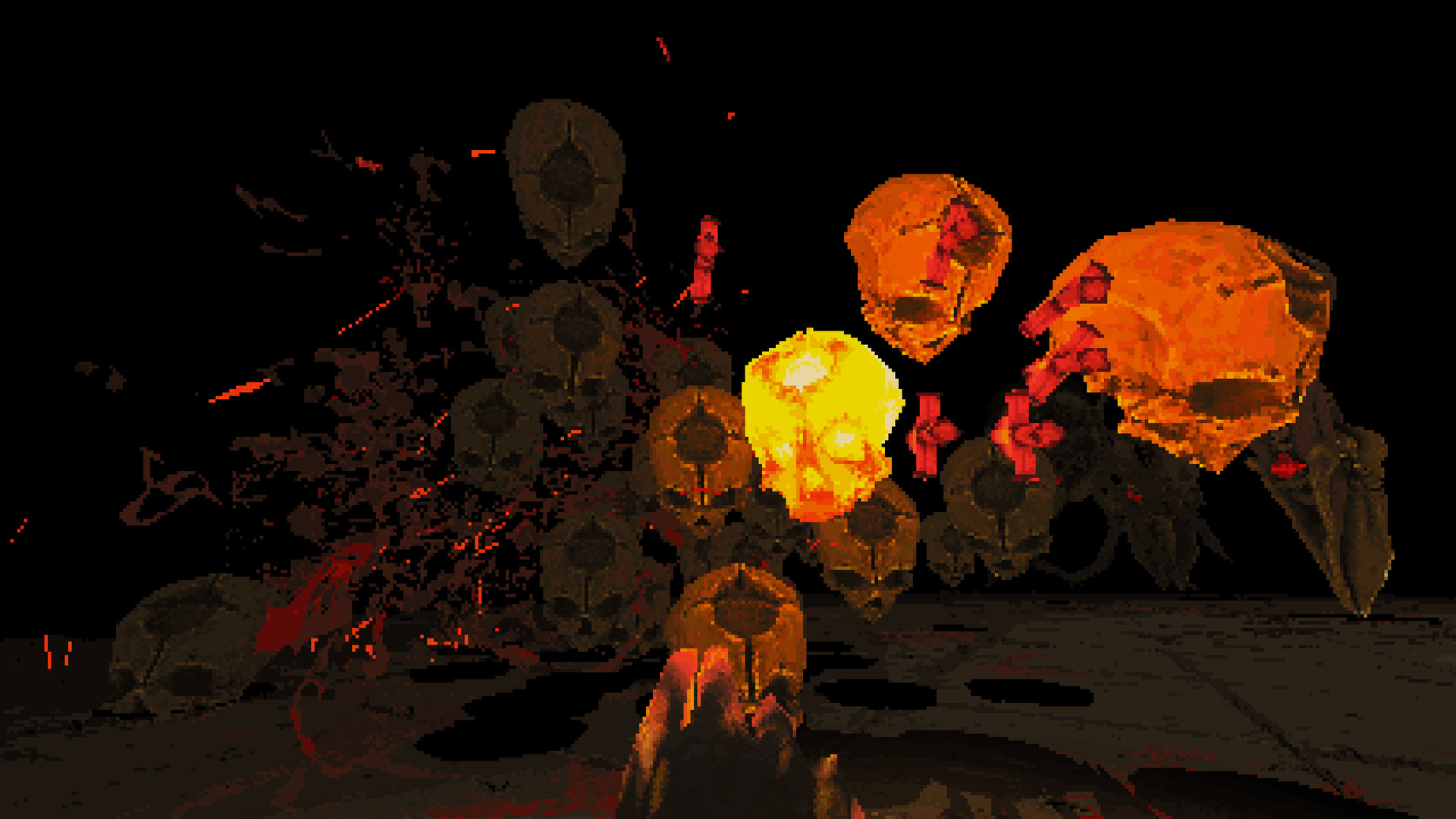
Devil Daggers begins in a circular black arena with a weapon, a survival timer and no campaign wrapper. Enemies arrive according to a sequence that quickly becomes recognizable, but recognition does not make execution easy. The objective is simply to remain alive longer, and the score is time measured with enough precision that a fraction of a second can become a meaningful personal record.
This simplicity removes excuses. There is no build to blame, no checkpoint to soften a mistake and no alternate route around an uncomfortable enemy. Each attempt asks whether movement, aim and priority were cleaner than before. A restart arrives immediately, keeping the emotional distance between mistake and correction extremely short.
The arena is read through sound
The most important enemies announce themselves with distinct calls, movement noise and attack signatures. A player who only watches the crosshair will be surrounded. Progress depends on building an audio map: knowing which threat spawned behind the current view, how close a pursuing mass has become and whether a dangerous generator is still active at the arena edge.
Headphones transform the experience because stereo position becomes tactical information. The soundscape is abrasive, but it is not random. Repeated attempts reveal a reliable language beneath the horror texture. A call that once produced panic eventually prompts a specific turn, jump or target change. Learning that vocabulary is as important as improving mouse accuracy.
Movement without a safe corner
The circular arena has no permanent cover. Survival comes from maintaining a route around its edge, cutting inward when space opens and using jumps to preserve speed or cross danger. Staying still is almost always a delayed failure. Movement must be continuous without becoming automatic, because a familiar orbit can lead directly into a newly spawned threat.
Advanced techniques emerge from the weapon itself, including ways to gain speed and height through controlled firing. They are not decorative tricks. Extra mobility changes which enemy clusters can be crossed and how quickly the player can recover the arena’s perimeter. Mastery looks like calm geometry: threats are grouped, space is created and the next turn begins before the current target falls.
Enemy priority as the hidden strategy
A large enemy is not automatically the most urgent. Some creatures generate future pressure, others restrict movement and smaller threats become lethal only when ignored long enough to fill the arena. The player gradually learns a priority table and then learns when to break it. A nearby collision can demand attention even while a distant source is creating a worse long-term problem.
This is the game’s strategic core. Aim matters, but selecting the right problem makes accurate shooting useful. Every second spent on the wrong target increases the density that must be managed later. High-level play appears impossibly fast because those priorities have become automatic. The player is not merely reacting sooner; they are deciding what the arena will look like several seconds ahead.
A severe visual contract
The low-resolution textures, red-black palette and distorted creatures make Devil Daggers feel hostile before the first hit. That hostility is purposeful. Enemy silhouettes remain distinct, projectiles cut against the floor and the absence of scenery keeps the arena’s usable shape clear. The style is oppressive without sacrificing the information needed to survive.
It can still be physically uncomfortable for some players. Rapid turns, flickering effects and relentless sound create a concentrated sensory load. There are no peaceful stretches to reset attention inside a run. Short sessions and sensible volume are part of playing well, not signs that the game lacks value. Its intensity is effective precisely because it does not dilute itself across a long campaign.
Practice, records and frustration
Improvement is exceptionally measurable. Surviving two seconds longer may indicate that one spawn was handled correctly for the first time. The global and personal record structure makes those gains visible without external progression. Nothing about the avatar becomes stronger; the player’s route, aim and recognition do.
The same purity can feel punishing. A late mistake erases a promising attempt, and repeating the opening sequence may become mechanical before the desired practice point arrives. There is no training room that isolates one wave. Anyone who needs structured lessons will have to create them mentally by focusing each run on a single correction rather than chasing a record every time.
Who belongs in the arena
Devil Daggers is for players who find a single uncompromising challenge more compelling than a large checklist. It rewards headphones, mouse control, patient repetition and the willingness to treat seconds as milestones. Readers seeking unlocks or narrative variety should pass. Readers who want to know exactly how their first-person fundamentals hold up under pressure will find an unusually honest test.