Housemarque’s twin-stick arena sprint turns rescue routes, enemy waves and hidden exits into a dense score-chasing performance.
- Format
- Twin-stick arena action
- Pace
- Explosive and exact
- Session
- 12–35 minutes
- Best for
- Players who route chaos for score
Movement is the first weapon
Nex Machina makes twin-stick control feel immediate: movement on one axis, fire on the other and a dash that cuts through danger with a brief burst of safety. The arena fills quickly, but success begins with positioning rather than raw aggression. A player who keeps an exit lane open survives longer and reaches rescues more reliably than one who simply points at the nearest enemy.
The dash is the defining verb because it turns walls of projectiles into route decisions. Used early, it keeps momentum and protects a multiplier. Used late, it becomes a panic correction that may land in another hazard. The best runs treat it like punctuation, crossing one dangerous sentence and arriving with enough space to read the next.
Rescue routes inside the firefight
Human rescues pull attention away from simple room clearing. Some stand in obvious lines, others require a quick detour and hidden ones reward breaking scenery or recognizing environmental hints. Their placement turns each arena into a route puzzle. A clean player enters already knowing which edge to sweep first and which rescue can wait until the enemy formation opens.
This is where score and survival stop being separate goals. Saving efficiently protects flow, while wandering after a missed target exposes the player to additional waves. Route memory therefore creates calm inside the spectacle. What initially looks like improvisation gradually becomes a practiced sequence with small adaptations for enemy position and weapon drops.
How the screen stays readable
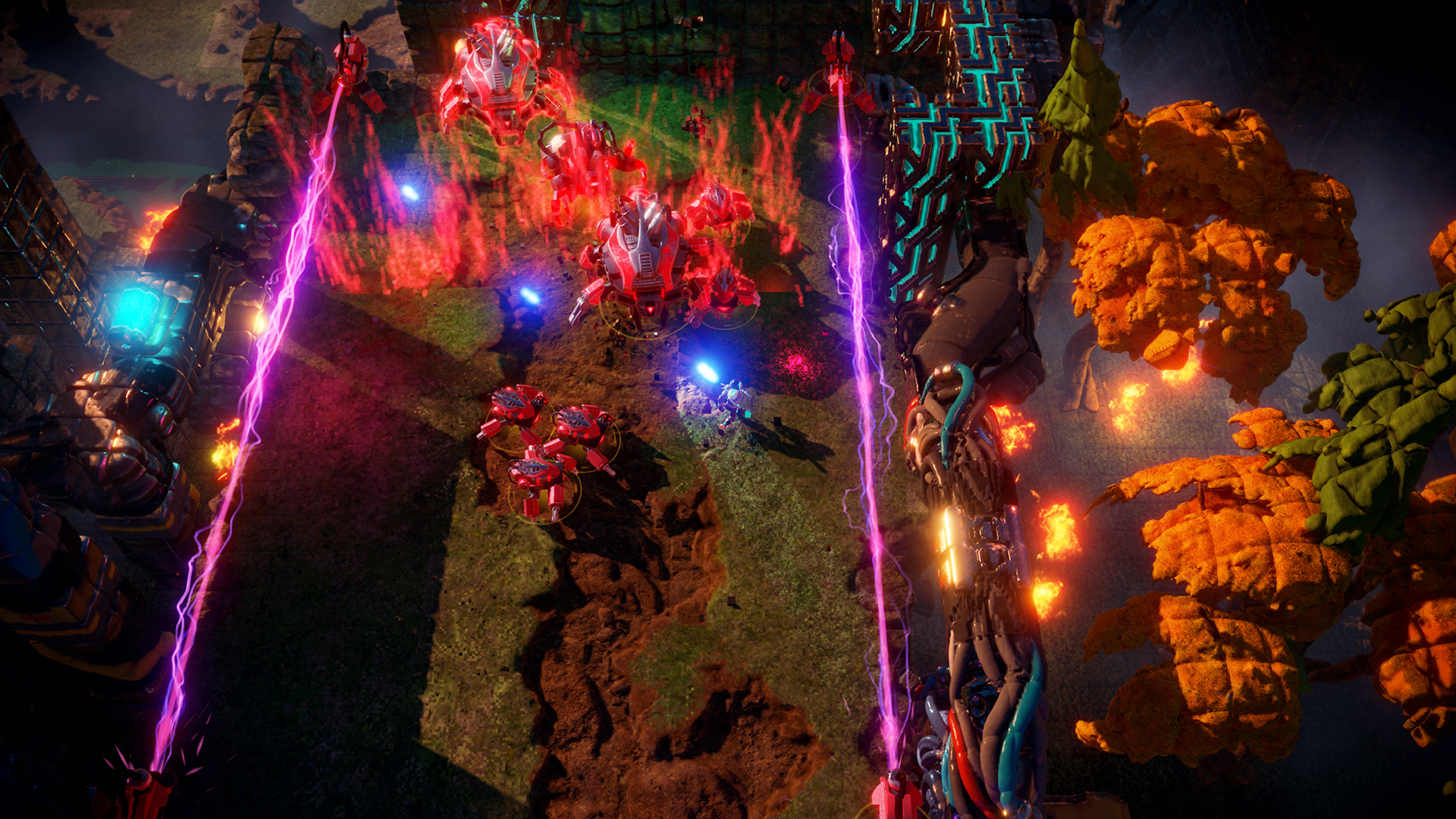
Color does unusually disciplined work. Hostile shots, player fire, civilians, exits and effects occupy distinct visual bands even when dozens of objects overlap. The image is bright without becoming an undifferentiated glow. Important threats have motion signatures as well as color, allowing peripheral vision to recognize a sweeping beam or closing enemy before the player consciously names it.
The occasional failure comes from the game’s own enthusiasm. A large explosion can briefly hide a smaller projectile, especially near the arena edge. Those moments are rare enough that the overall visual language remains trustworthy. Sound reinforces it with sharp rescue confirmations, multiplier cues and an unmistakable dash response, helping the player keep rhythm without staring at interface numbers.
Scoring changes every room
Finishing an arena is only the entry-level objective. A score run asks for uninterrupted kills, complete rescues, discovered secrets and a route that wastes almost no movement. Those demands change weapon priorities. A temporary upgrade is valuable not only because it clears danger, but because it may preserve a chain through the seconds when enemies would otherwise be out of reach.
The result screen makes improvement concrete. A modest advance can be traced to one cleaner room rather than an opaque character upgrade. This transparency encourages immediate replay. The player knows which civilian was missed, which secret route broke and where a dash disrupted the multiplier. Each failure returns a specific idea for the next attempt.
Difficulty and restart economy
Lower settings allow the rescue structure and weapon language to become familiar without erasing the need to move. Higher settings increase density until every dash must have a destination. The curve is demanding, but it is not built around long walks back to the action. Rooms begin quickly and a lost run can be restarted before frustration cools into disengagement.
A complete session is longer than a one-screen survival game, so the cost of a late mistake can still sting. The design earns that tension by making early worlds enjoyable to route again. Repetition is active refinement, not a slow tutorial corridor. Players who only want to see new scenery may find the repeated opening demanding; score players will recognize it as the performance being rehearsed.
Limits of constant intensity
Nex Machina has little interest in a quiet middle register. Even visually calmer rooms are preparing the next burst, and the soundtrack keeps pressure high. That consistency creates a strong identity but can make a long session tiring. Short breaks between runs improve performance because the game asks for broad visual attention and continuous thumb tension.
The campaign framing is functional rather than emotionally elaborate. Civilians supply a score route and a readable rescue goal, not a story with evolving characters. Anyone seeking narrative context will find the arcade purity austere. The reward is mechanical coherence: almost every object on screen affects survival, score or movement, and very little exists only to delay the next meaningful decision.
Who should chase the route
Nex Machina is for players who enjoy turning a frightening first impression into a memorized route, then pushing that route under greater pressure. It combines immediate controls with enough hidden structure to support serious score study. If bright arenas, rapid restarts and small measurable improvements sound energizing rather than exhausting, this is one of the clearest modern expressions of PC arcade design.