Falling, shooting and landing share the same compact control language, turning every descent into improvised route management.
- Format
- Vertical action roguelite
- Pace
- Falling with deliberate pauses
- Session
- 6–25 minutes
- Best for
- Players who improvise compact routes
One input solves two problems
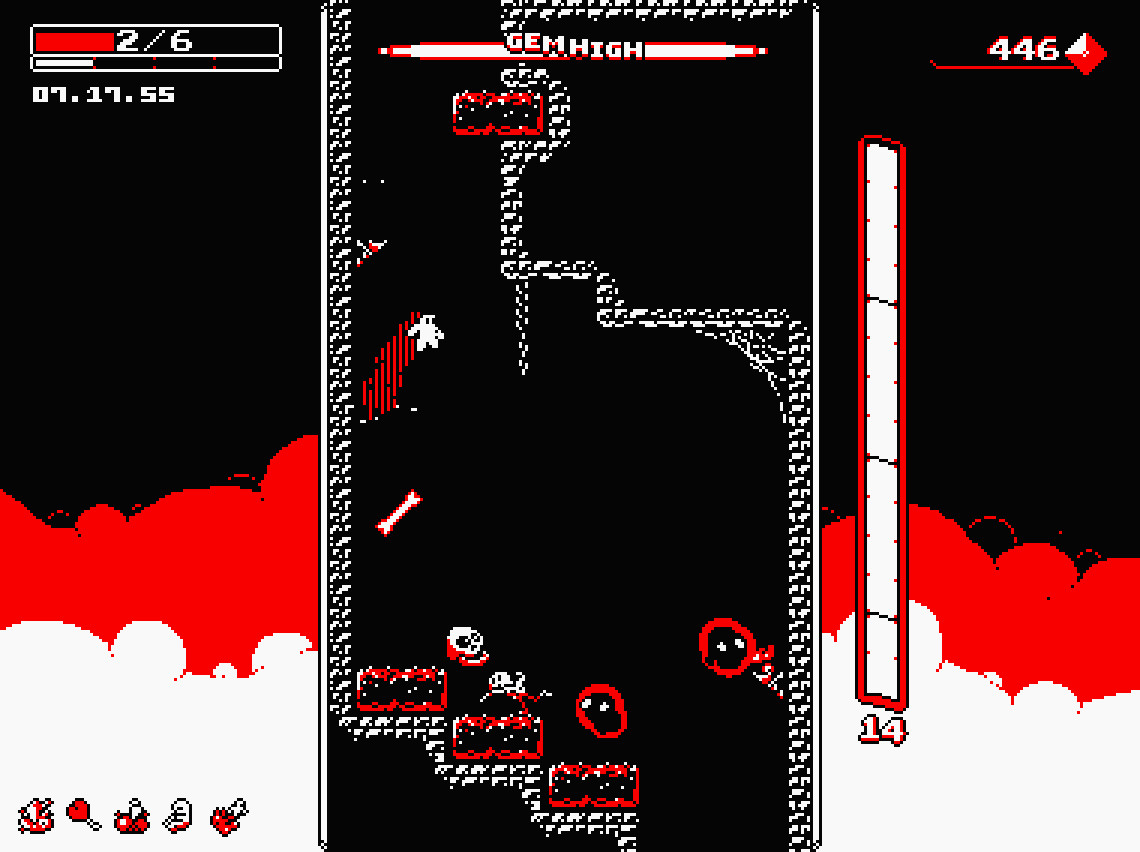
Downwell’s gunboots fire downward, damaging enemies while slowing the fall. That single relationship defines the game. Shooting is offense, air control and a way to buy time before the next platform arrives. Ammunition refreshes on landing, so every descent alternates between spending control in the air and searching for a safe surface that restores it.
The design feels elegant because no button exists only for a secondary system. Left and right choose a line, jump begins the drop and firing reshapes that drop. New players often shoot until the magazine is empty, then discover too late that the nearest platform is unsafe. Better players leave enough shots to correct a bad read or extend a combo past an awkward gap.
Looking below the visible edge
The camera shows enough space to make a decision but not enough to remove uncertainty. The next enemy or platform may enter just after commitment. This creates a useful tension between speed and information. Falling quickly preserves combo energy, while a brief hover created by gunfire reveals more of the shaft and may expose a safer landing.
Good routes are therefore improvised rather than fully memorized. Room families become recognizable, yet exact enemy placement and upgrade context still matter. Downwell rewards principles: avoid blind center drops, keep one correction available, prioritize surfaces with escape lanes and understand which colored enemies can be safely stomped. Those habits travel across runs even when the layout changes.
Combos versus survival
Chains continue while the character stays airborne and interacts cleanly with enemies or objects. Pursuing them turns a cautious platformer into a flowing dive. The temptation is powerful because a long uninterrupted descent feels spectacular, but the route may demand more ammunition than the current weapon supports. Every combo is a negotiation between style and the next safe reset.
This risk produces real authorship. A player can break the chain, land and stabilize, or continue through a narrow opening for a stronger reward. Neither choice is universally correct. Health, weapon type and visible geometry change the answer. The best moments arrive when a brave continuation was not reckless because the player had already mapped the landing two screens below.
Palettes that improve recognition
Downwell uses very few colors at once. The limited palette is an accessibility tool as much as an aesthetic signature: background, danger, pickups and the player remain separable during rapid vertical motion. Unlockable palettes change mood without rewriting the hierarchy. Even when the screen fills with fragments, the important collision shapes retain hard edges.
Small sprites also keep animation honest. An enemy’s movement pattern is visible before decorative detail, and a platform does not hide its usable surface. The audio follows the same philosophy. Shots are dry, landings are firm and combo milestones add emphasis without turning the descent into noise. The presentation trusts repetition and rhythm rather than cinematic interruption.
Upgrades and run identity
Between stages, upgrades alter how the same controls solve problems. More health supports recovery, different gunboot behavior changes aerial duration and shop choices can trade safety for future power. The selection is compact enough that each option remains understandable. A run develops a character without requiring a spreadsheet or a long inventory inspection.
Randomness matters, but execution remains central. A helpful upgrade cannot rescue repeated blind drops, while an awkward weapon can still succeed when its ammunition rhythm is respected. This balance makes failure instructive. The player can identify a routing mistake instead of blaming every ending on the offered build, then carry that lesson into a differently equipped descent.
Where compactness becomes severity
Downwell asks for precision while withholding a complete view of the space below. Some damage will feel unfair until enemy families and camera timing become familiar. The early game can therefore seem harsher than its three-button layout promises. It is not a relaxing falling toy; it is a demanding action game compressed into small decisions.
Runs also repeat visual material by design. Players motivated primarily by new scenery may not value the way familiar shaft pieces combine into different tactical problems. The intended satisfaction comes from moving more fluently through known language. If that kind of refinement feels repetitive, the sparse art and short loop will not disguise it.
Who should make the descent
Downwell is ideal for players who want a complete run in a short sitting and enjoy controls where every action has several uses. It supports cautious survival, aggressive combo hunting and the gradual discovery that both styles can coexist. The game is small in footprint but unusually dense in consequence, making it a durable choice for portable or desktop score sessions.