Bright roads, decisive steering and compressed races rebuild the spirit of classic checkpoint driving without imitating old hardware.
- Format
- Checkpoint arcade racing
- Pace
- Fast and approachable
- Session
- 4–25 minutes
- Best for
- Players who value readable racing lines
Steering toward the horizon
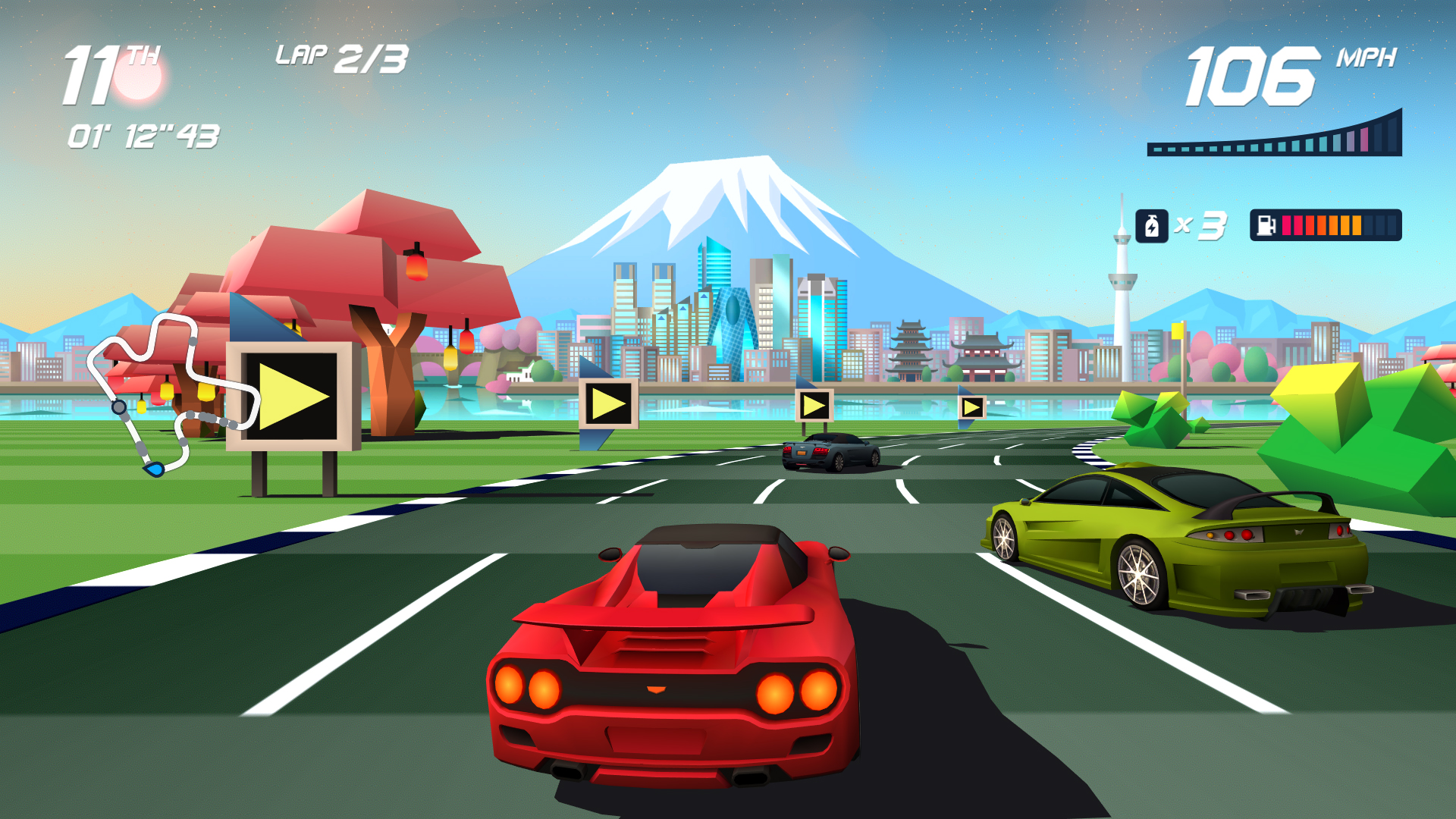
Horizon Chase Turbo uses a trailing road perspective and broad steering response to make speed readable before it becomes realistic. Cars slide laterally with a deliberate immediacy, allowing the player to choose a line through traffic without managing a simulation model. The road bends toward a colorful distance, so upcoming corners are communicated as changes in composition as much as changes in asphalt.
That clarity makes the first race welcoming. Acceleration, steering, boost and occasional braking cover the essential language. Depth arrives through when to use them: carrying speed through a long curve, avoiding contact before a checkpoint and saving boost for a straight where traffic will not waste it. The controls are generous, but careless lines still cost positions.
Traffic is the moving obstacle course
Opponent cars create more than a ranking. They form temporary walls, narrow the preferred line and force overtakes before the next bend. A small collision can drain momentum without ending the race, which keeps mistakes recoverable while preserving their importance. The player is constantly reading gaps rather than following one empty ideal route.
Good overtakes begin early. A car approaching the outside of a curve may leave an inside opening that disappears once the pack compresses. Boosting into that space feels excellent when the road remains visible beyond it. Boosting blindly produces a chain of contact and proves that speed without route reading is only noise. The game’s arcade character comes from making that lesson immediate and repeatable.
Checkpoints shape the race
Fuel and position markers divide each course into understandable sections. The player knows whether a poor opening can still be recovered and whether collecting track items is worth leaving the clean line. This checkpoint rhythm gives even a short event internal chapters: crowded launch, settled middle, late boost decision and final traffic push.
Collectibles add a secondary route without turning the track into a scavenger hunt. Their placement often asks for a wider line or a deliberate pass through traffic. Completion-focused players will replay for clean collection and a strong finish, while casual racers can ignore perfection and continue through the tour. Both goals use the same readable road language.
Color as geography
Countries and regions are expressed through bold skies, roadside silhouettes and dramatic weather rather than photorealistic detail. The art creates memory anchors: a particular sunset, snow field or city edge becomes inseparable from the turns that followed it. That makes a large track list easier to recall and gives progression the feeling of travel.
Strong color rarely interferes with the racing surface. Road boundaries, traffic and pickups maintain enough contrast to remain readable at speed. Some weather effects briefly reduce clarity, but they also create a deliberate change in concentration. The soundtrack completes the old-arcade spirit with forward-moving melodies that support momentum without dictating exact input timing.
Cars, upgrades and local play
New cars and upgrades provide a gentle progression layer. Statistics matter, yet a stronger vehicle cannot completely hide repeated collisions or poor boost use. The system gives less experienced players a reason to continue while score-minded drivers can revisit earlier events with improved knowledge and cleaner lines.
Local multiplayer reinforces the cabinet appeal. A race is short enough for rotation, and the control scheme is understandable to someone joining without a long setup. Split-screen naturally reduces visual space, so the bold road and large car silhouettes become functional advantages. The mode values quick competition over complex event management, fitting the broader design.
Where nostalgia narrows the model
Handling is intentionally stylized. Players who want detailed weight transfer, tuning or realistic braking will find the car response too broad. Track mastery is about traffic, curve timing and resource use rather than simulating a particular vehicle. The game should be judged against arcade racing, not against a motorsport sandbox.
Progression can also make early failures easier to solve later, slightly blurring whether improvement came from the player or the garage. Time-focused readers may prefer comparing runs with the same car and settings. Even with that caveat, the short event length and visible collection goals create a generous replay structure that does not require a long uninterrupted campaign session.
Who should take the grid
Horizon Chase Turbo is a strong fit for players who remember checkpoint racers, families sharing local races and anyone who wants speed without a simulation tutorial. Its color, road readability and compact events make it approachable, while traffic routing and clean collection give practiced drivers something to refine. It is nostalgic in spirit but confident enough to use modern pacing and presentation.