Momentum-heavy dogfights, modular aircraft parts and a tiny battlefield turn every launch into a risky aerial improvisation.
- Format
- Two-dimensional aerial survival
- Pace
- Loose, risky and escalating
- Session
- 2–15 minutes
- Best for
- Players who enjoy expressive momentum
Flight as controlled falling
LUFTRAUSERS does not steer like a conventional side-scrolling shooter. The aircraft rotates, thrusts and carries momentum, so pointing at a target is only part of the problem. Releasing thrust can turn a climb into a graceful fall, while firing changes attention and sometimes movement at the worst possible moment. The plane always feels slightly wild, but its behavior is consistent enough to learn.
The first breakthrough is understanding that the nose does not need to point in the direction of travel. A player can drift one way while turning to fire elsewhere, then apply thrust to reshape the arc. That separation makes dogfights expressive. Success looks less like following lanes and more like drawing temporary loops through a crowded patch of sky.
A battlefield with no quiet edge
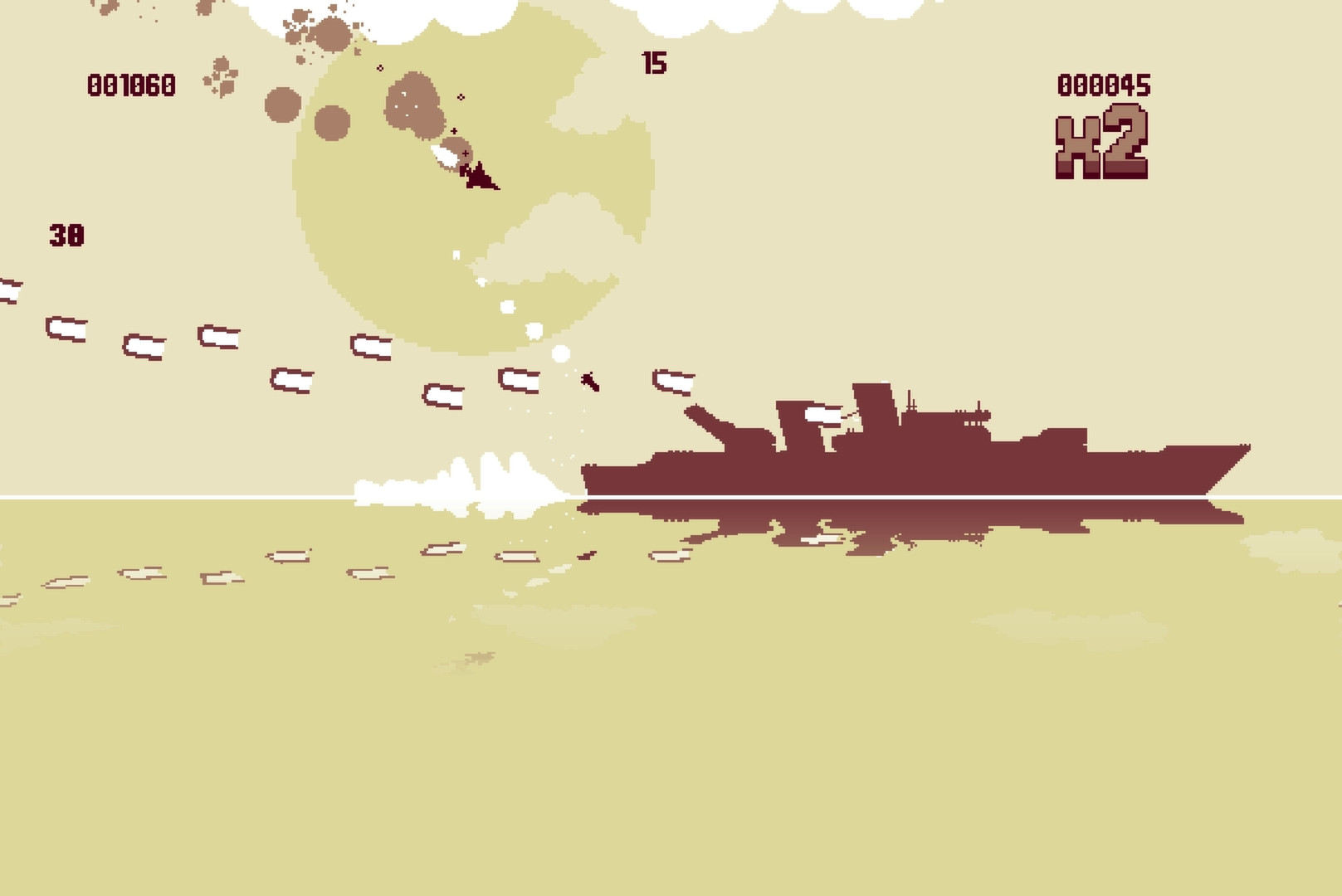
The play area is compact, bounded by sea below and escalating pressure above. Enemies arrive from several directions, and leaving one type alive too long can transform the entire space. Small fighters restrict turns, boats punish low passes and larger threats demand sustained attention. The player is constantly deciding which pressure will become unmanageable first.
Because the battlefield wraps attention back toward the center, escape is temporary. A long dive may clear one cluster but brings the ocean into the route. A high climb opens space while exposing the plane to a different group. The best movement solves two problems at once: crossing a safe line while placing the nose where the next priority target will appear.
Parts that change the handling story
Weapons, bodies and engines can be combined into aircraft with distinct rhythms. One build may recover health while not firing, encouraging brief evasive spirals. Another may trade control for destructive bursts or alter how quickly thrust changes direction. These parts do more than raise statistics; they redefine when the player feels safe enough to attack.
Experimentation is therefore part of the arcade loop. A weak run may reveal that a build asks for habits the player does not enjoy, while an unfamiliar combination can make an old target order feel new. Challenges encourage specific parts without requiring one permanent progression path. The garage is a way to select a play style before launch, not a long crafting economy.
Scoring rewards dangerous continuity
Kills build momentum and invite the player to remain engaged instead of retreating into a safe orbit. Chasing the next target while the screen is already busy creates the strongest score opportunities and the most dramatic failures. A run often ends because one extra attack was attempted without enough space to recover.
That risk is readable. The player generally knows when the route became greedy: a turn was tightened, thrust was held too long or a large target absorbed attention while smaller enemies filled the sky. Fast restarts turn that recognition into another launch. There is almost no administration between a failed idea and its revised version.
Limited color, strong silhouettes
The visual palette is deliberately narrow, using hard silhouettes and a small set of tones to keep aircraft, shots and sea distinct. The style resembles a worn poster in motion, but recognition remains the priority. Enemy classes can be identified by outline and movement before fine detail would matter.
Explosions briefly fill the small field with particles, creating both celebration and risk. A destroyed large target can hide a fighter crossing behind it, so experienced players continue moving through the effect instead of treating it as a pause. The soundtrack adds swagger without setting a strict rhythm, matching flight that is expressive rather than metronomic.
Difficulty and the cost of looseness
Momentum controls can feel imprecise during the first hour. The plane overshoots, the nose swings past a target and the sea punishes a turn that began too late. Those errors are not random, but the path from intention to motion is less direct than in a twin-stick shooter. Players must enjoy learning a physical model rather than expecting the craft to obey the cursor immediately.
The small arena and rapidly rising density also mean that a run can collapse in seconds. There are few recovery resources once several enemy types overlap. That severity is balanced by the short restart and the pleasure of a clean launch. Anyone who dislikes repeated early failure may not remain long enough for the aircraft’s looseness to become expressive control.
Who should launch again
LUFTRAUSERS is for players who want a shooter where movement itself is the main toy. Modular parts, compact runs and rising target pressure provide structure, but the lasting appeal is the sensation of redirecting momentum at the last possible moment. It is messy in a deliberate way: a small, stylish dogfight machine that rewards improvisation without hiding its mistakes.