A wordless life story told through boxes, changing rooms and the revealing question of where each familiar possession belongs.
- Format
- Domestic placement puzzle
- Pace
- Reflective and steady
- Session
- 20-50 minutes
- Best for
- Players who read stories through spaces
Opening boxes becomes a way of meeting someone
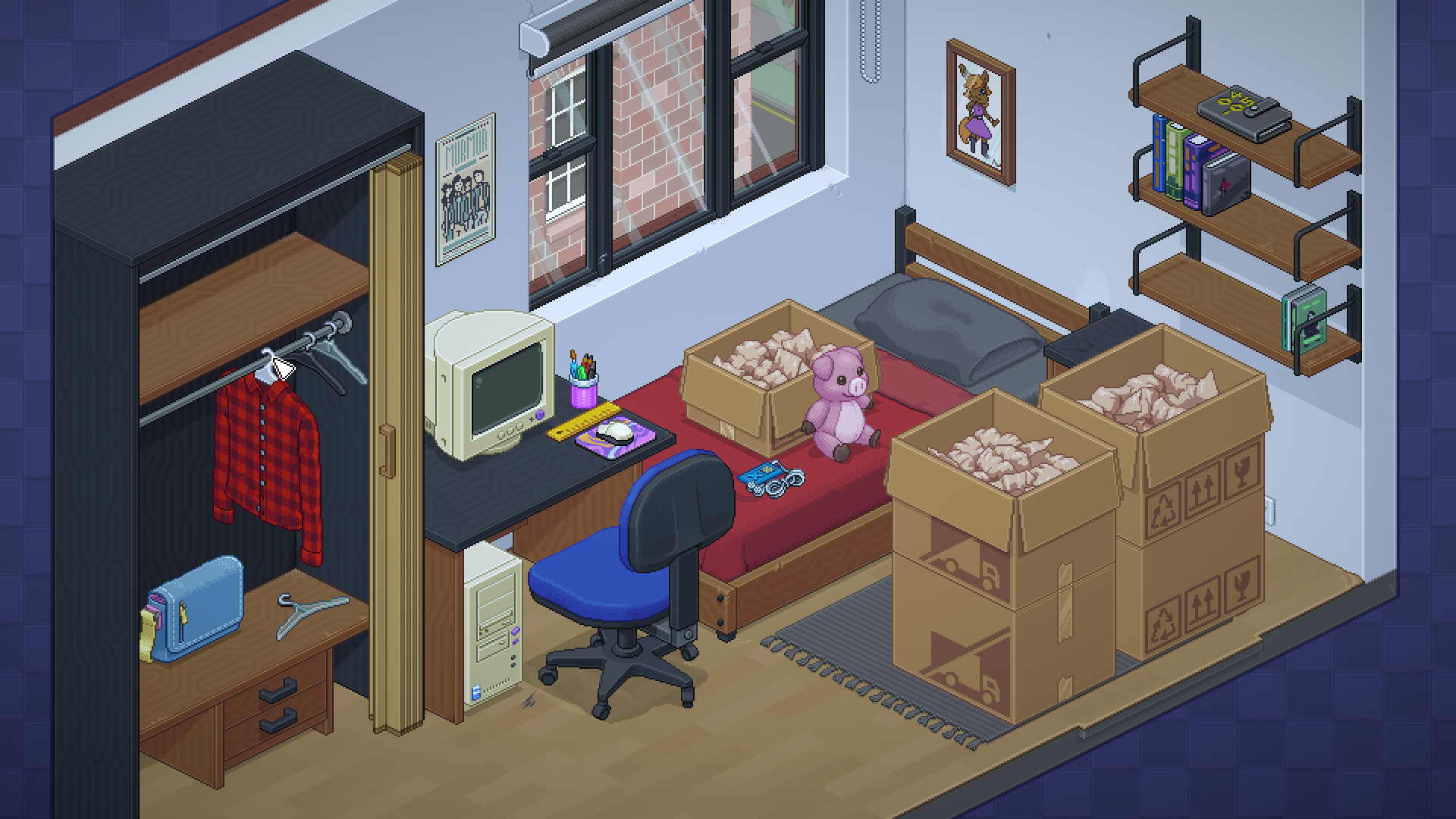
Unpacking starts with cardboard boxes in a childhood bedroom and asks the player to find a place for every object inside. There is no written biography explaining the owner. Instead, a favorite toy, school supplies, sports equipment and a carefully protected keepsake suggest interests and routines. Later moves revisit familiar possessions in new homes, allowing continuity to carry the story. The simple act of lifting an item from paper and deciding where it belongs becomes a form of character reading. Because the player performs the arrangement, discoveries feel personal rather than delivered by a cutscene. A room is complete only after its contents make practical and emotional sense together.
Placement rules reveal each room's constraints
Objects cannot be dropped anywhere without consequence. Toothbrushes belong near a sink, clothes need drawers or hangers and cookware requires the limited shelves of a kitchen. These rules are forgiving enough to support personal arrangements, yet firm enough to make the rooms puzzles rather than blank decorating canvases. The challenge comes from volume and space: a promising shelf may fill before the last box is opened, forcing an earlier decision to be reconsidered. Good play involves surveying cupboards, identifying unusually shaped items and leaving flexible gaps. The logic stays grounded in ordinary use, so solving rarely requires a hidden trick; it asks the player to inhabit the space attentively.
The home tells a story without dialogue
Every move changes the surrounding context. A larger house may offer more storage but reveal the compromises of sharing space. A cramped room can show which possessions are welcomed and which have nowhere respectful to go. The most effective narrative moments emerge from placement restrictions that suddenly carry social meaning. An item that once occupied a proud position may be pushed into an awkward corner, and the game trusts the player to understand why that feels wrong. This environmental approach avoids turning belongings into a scavenger hunt for lore. The objects are useful first, recognizable over time, and emotionally charged because the player has handled them across several chapters.
Sound makes small actions satisfying
Different materials respond with distinct soft sounds: ceramic settles differently from fabric, a book meets wood with a muted tap and a hanger clicks into a rail. These details give the cursor a sense of weight even though interaction is limited to picking up, rotating and placing. Music remains supportive rather than instructive, leaving enough space for the rhythm of unpacking to lead the scene. The presentation also uses readable pixel art to distinguish a surprising number of household objects at a glance. When an item is unfamiliar, its shape and the rooms that accept it provide clues. The combined audiovisual restraint keeps long sorting sessions comfortable and makes completion feel earned through accumulated care.
Freedom and correction stay in balance
Most valid objects can occupy several sensible locations, so a completed room still reflects the player's preferences. Incorrect placements are identified after the boxes are empty, allowing experimentation before judgment. This is a considerate structure: the game does not interrupt every imperfect move, but it also prevents progression while essential belongings remain somewhere implausible. Accessibility options can relax parts of that validation for players who want the tactile and narrative experience without the full spatial puzzle. The distinction broadens the audience without weakening the standard rules. Unpacking understands that organization can be soothing for one player and stressful for another, then provides enough control to preserve its central pleasure in either case.
Repetition is meaningful but still repetition
The core action changes very little from chapter to chapter. Players repeatedly open boxes, rotate objects and search for shelf space, with narrative context doing more to refresh the loop than new mechanics. Anyone who needs escalating systems may find later homes too similar at the level of input. There can also be brief frustration when a tiny item has only one acceptable type of surface or when the remaining invalid object is hard to spot in a crowded room. The generous pace and clear highlighting reduce these problems, but do not remove them. The experience works best when arranging itself is satisfying, not merely tolerated as a route to the next story beat.
Who should make room for this story
Unpacking suits players who enjoy quiet observation, environmental storytelling and puzzles based on familiar physical logic. It asks for patience rather than speed and offers an emotionally complete arc without lengthy dialogue or demanding controls. People who have attached memories to ordinary possessions may find its repeated objects especially affecting, while detail-oriented organizers can enjoy building efficient, believable rooms. It is less suitable for players seeking open-ended interior design, since each home and inventory are fixed, or for those who want difficult abstract puzzles. As a compact study of how belongings follow a person through change, it turns an everyday task into a remarkably clear form of interactive biography.