A quiet tile-laying landscape where every placement balances immediate beauty against the long shape of rivers, rails and villages.
- Format
- Hexagonal tile puzzle
- Pace
- Quiet and deliberate
- Session
- 15-45 minutes
- Best for
- Players who enjoy spatial planning
A landscape assembled one decision at a time
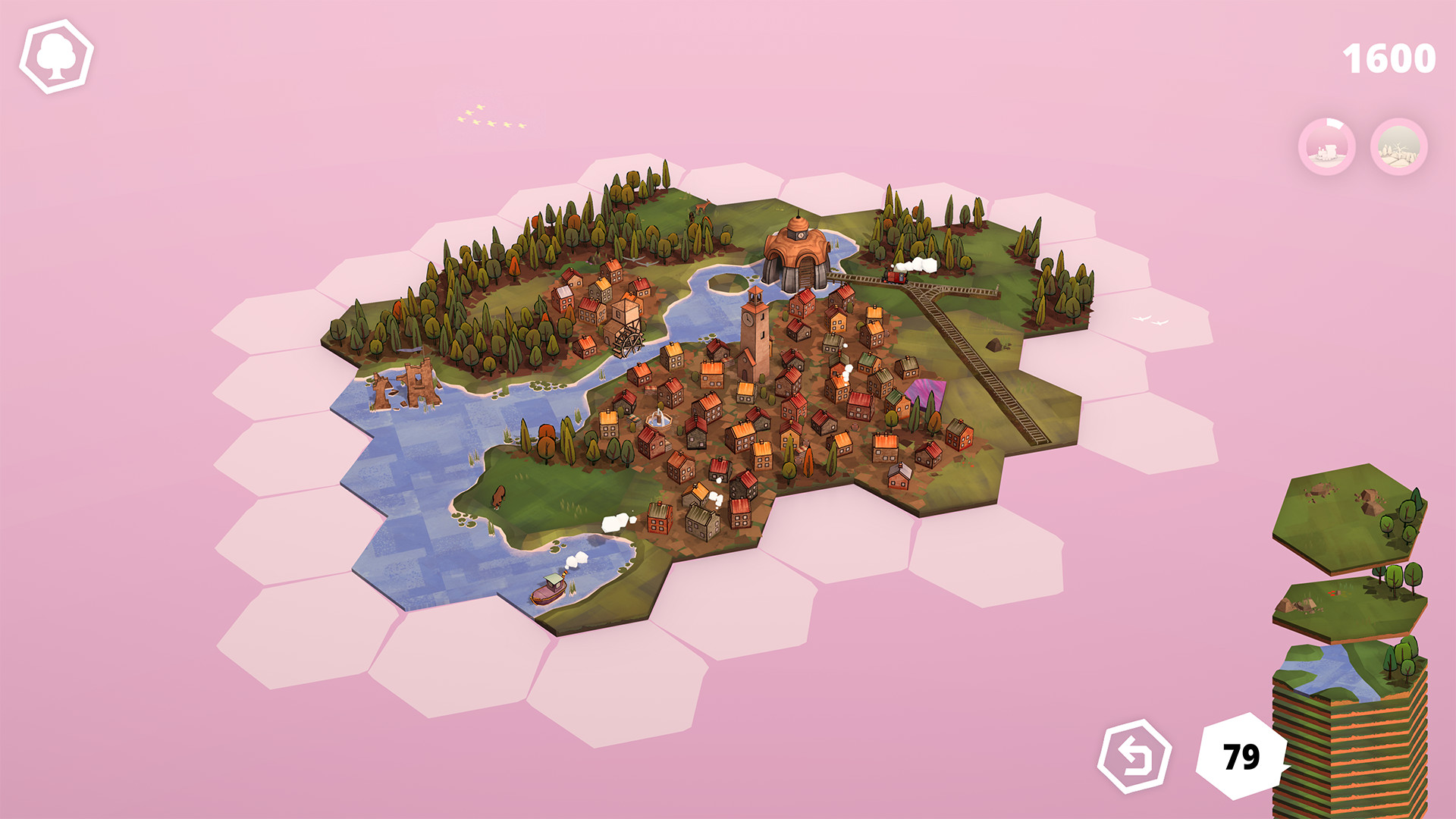
Dorfromantik begins with a small stack of hexagonal tiles and an empty field. Each tile carries fragments of forest, village, water, rail or farmland, and the simple task is to place it against the growing map. The calm presentation can make the first turns feel decorative, but every edge matters. A rail that points into open space needs a future connection, while a closed forest may complete a quest and release more tiles. The landscape becomes both a picture and a record of past commitments. That double purpose is the source of the game's distinctive tension: a placement can look lovely now while quietly making the next ten turns harder.
Quests create direction without a rigid route
Small quest markers ask for a region to reach a certain size or, occasionally, to stop at an exact number. They provide enough direction to prevent aimless matching without dictating a single correct map. Several objectives often overlap, so joining one village may also extend a field and create room for a later rail. The strongest turns solve an immediate request while preserving flexible borders for unknown tiles. Because the upcoming pieces are only partly visible, planning is probabilistic rather than exact. Dorfromantik rewards players who create useful options, recognize which commitment is becoming dangerous, and accept that a beautiful plan may need to bend when the tile stack refuses to cooperate.
Perfect matches change how the board is read
Matching every edge around a tile earns a perfect placement and pushes score play beyond merely connecting like terrain. The rule encourages compact clusters, deliberate boundaries and careful use of neutral edges. It also changes attention: instead of looking only at the active piece, an experienced player scans unfinished pockets across the whole map. A seemingly awkward tile can become valuable if it seals several edges at once. The visual feedback remains gentle, yet the scoring logic is precise enough to support improvement. High scores come from seeing the board as a network of future sockets, not from making the largest possible forest or village at every opportunity.
Readability makes a large map manageable
The miniature world stays readable because terrain types use strong silhouettes as well as color. Rails draw thin mechanical lines, rivers curve with clear banks, fields create broad yellow planes and forests form dense textured masses. Zooming out reveals the overall composition, while a closer view exposes edge details before a placement is confirmed. The interface keeps the current tile, upcoming preview and remaining stack visible without surrounding them with unnecessary panels. Even after the map spreads in several directions, navigation feels more like examining a tabletop than operating a complex strategy screen. That restraint supports concentration and lets the landscape itself communicate most of the information a turn requires.
A calm surface with meaningful pressure underneath
There is no conventional timer, enemy or sudden punishment, but the shrinking tile stack supplies steady pressure. Completing quests and perfect matches extends a run; careless borders gradually reduce that opportunity. The result is a forgiving rhythm rather than a consequence-free toy. Players can pause to consider a difficult shape, then place it knowing that one imperfect edge will not destroy the session. This makes Dorfromantik unusually suitable for short evening play: it offers genuine decisions without demanding rapid input. A run can also become absorbing, because each completed objective reveals another small problem and every new tile suggests one more adjustment to the landscape.
Where the puzzle can feel narrow
The same consistency that makes Dorfromantik relaxing can limit its dramatic range. Most turns use the same core vocabulary, and long sessions do not introduce the kind of tactical surprise found in a campaign puzzle game. Random tile order can also make an exact quest frustrating when the required edge arrives too late. The design softens this through flexible scoring and multiple goals, but players who need authored levels or a strong narrative may find the open-ended structure diffuse. Its progression is about becoming a better observer and unlocking additional tile variations, not discovering a sequence of radically different mechanics or story events.
Who should build this countryside
Dorfromantik is an excellent fit for players who like spatial puzzles, gentle optimization and games that respect an unhurried pace. It works as a low-pressure creative activity, yet there is enough structure for score chasers to study perfect edges, quest timing and efficient expansion. The best audience will appreciate that beauty and strategy are not separate modes: the most satisfying maps often emerge from disciplined placement, while an elegant river bend can inspire a practical new route. Anyone seeking action, social competition or a tightly scripted finish should look elsewhere. For thoughtful solo play, however, this landscape offers a durable reason to place one more tile.