Everyday drawers, books and utensils become tactile arrangement puzzles with several convincing answers and a mischievous cat nearby.
- Format
- Tactile arrangement puzzles
- Pace
- Observant and relaxed
- Session
- 10-30 minutes
- Best for
- Players who notice small patterns
Order discovered in ordinary objects
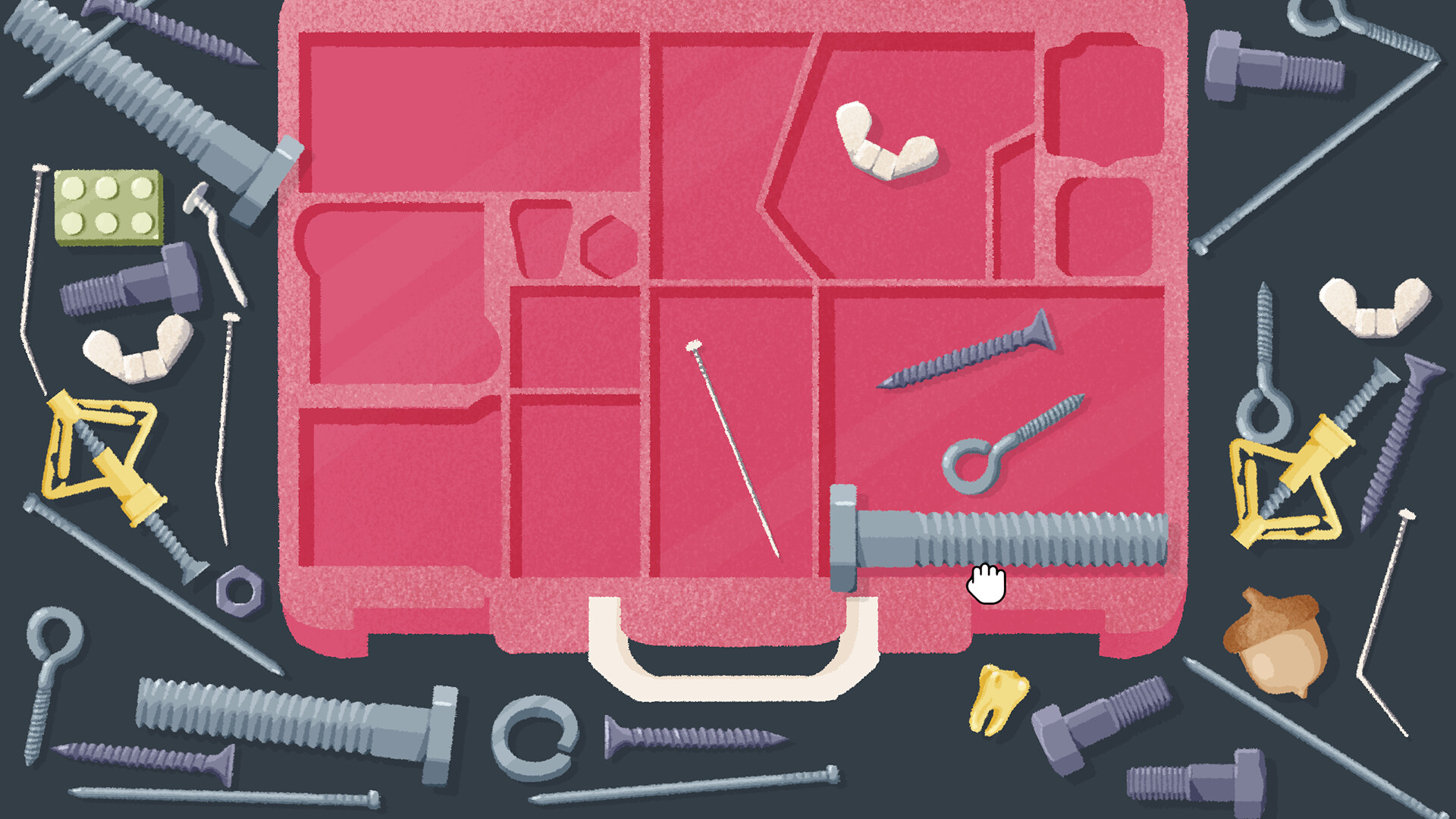
A Little to the Left turns the visual habits of a tidy desk into a sequence of self-contained puzzles. Books lean at uneven angles, spoons wait to be nested, papers hide repeated shapes and pantry labels suggest an unspoken system. The player drags each object directly, testing alignments until the arrangement clicks. There are almost no abstract symbols to learn because the household materials carry the logic themselves. A successful answer might follow size, color, symmetry or the continuation of a printed line. This makes every scene approachable at first glance while leaving enough ambiguity for observation to matter. The puzzle is not simply to clean; it is to infer what kind of order this particular collection wants.
Touch and motion are part of the reasoning
Dragging an object is pleasantly physical. Items slide with a little resistance, stack in readable layers and settle into position without feeling magnetized from across the screen. That responsiveness matters because many solutions depend on tiny spatial relationships. A book spine aligned by only a few pixels should feel intentional rather than lucky. The cursor becomes a hand that can try, compare and revise, keeping experimentation close to the object instead of routing it through menus. When an arrangement is complete, the confirmation is brisk and clear. The game avoids turning every success into a loud reward, preserving the private satisfaction of seeing a disordered group finally become coherent.
Multiple solutions respect different instincts
Some scenes accept more than one organizing principle. A set of objects may form a gradient, mirror around a center or align according to marks that were easy to overlook. These alternate answers are more than optional collectibles: they acknowledge that visual order is not always singular. After finding one solution, returning to the same pieces with a different question can reveal details that seemed decorative before. The approach prevents the game from behaving like an examiner with one hidden thought. It still demands evidence from the scene, but it rewards several defensible readings. That generosity is especially valuable in puzzles built from domestic intuition, where two people may naturally sort the same drawer in different ways.
Hints guide without replacing the observation
When a scene becomes opaque, the hint system presents a sketch of the intended arrangement beneath a layer the player can erase gradually. Revealing only a corner may be enough to identify orientation or spacing, while exposing the whole drawing provides a direct way forward. This variable assistance is better matched to visual puzzles than a text explanation would be. It lets players choose how much discovery to preserve and avoids trapping the broader sequence behind one unreadable clue. The system also makes the game welcoming to households that solve together, since a small reveal can restart conversation rather than end it. Progress never depends on pretending that frustration is the same thing as difficulty.
The cat interrupts perfection at useful moments
A recurring cat occasionally disrupts a careful arrangement, batting at objects or claiming the exact space the player wants to organize. These appearances supply comic friction and prevent the theme of tidiness from becoming overly precious. They also introduce motion into a game dominated by still life composition. The cat is not a constant obstacle, so the joke remains a change of rhythm rather than a punitive mechanic. Its presence reinforces the idea that domestic order is temporary and personal. The world does not become sterile when a puzzle is solved; it remains a lived-in place where a paw can undo the straightest row and the player can smile before trying again.
Where ambiguity becomes friction
Not every arrangement communicates its rule with equal confidence. A few puzzles depend on noticing a mark that blends into the illustration or on placing an item more precisely than the broader visual language suggests. In those moments, a correct idea can feel rejected because execution and interpretation are hard to separate. Repetition is another limit: players who do not enjoy sorting for its own sake may find the variations gentler than expected. The game builds a wide vocabulary from alignment, nesting and pattern recognition, but it rarely abandons that central fantasy. Its calm tone is a deliberate strength, although it means dramatic escalation and complex systemic combinations are not the main attraction.
Who will enjoy putting everything in place
This is a strong recommendation for players who enjoy visual logic, direct manipulation and the small relief of turning clutter into a readable pattern. Short levels make it easy to play between other tasks, while alternate solutions and daily puzzles provide reasons to return without demanding a long campaign session. It is also approachable for people who find grids, equations or wordplay intimidating, because its clues live in familiar shapes and materials. Players seeking speed, competition or elaborate narrative consequences will find the scale modest. For an audience that notices crooked frames and uneven stacks, A Little to the Left transforms that instinct into a warm, carefully paced puzzle collection.