A clean transit diagram becomes a living logistics puzzle as new stations test every line, carriage and crossing you thought was settled.
- Format
- Real-time network puzzle
- Pace
- Calm until capacity tightens
- Session
- 10-35 minutes
- Best for
- Players who optimize evolving systems
A map that grows faster than certainty
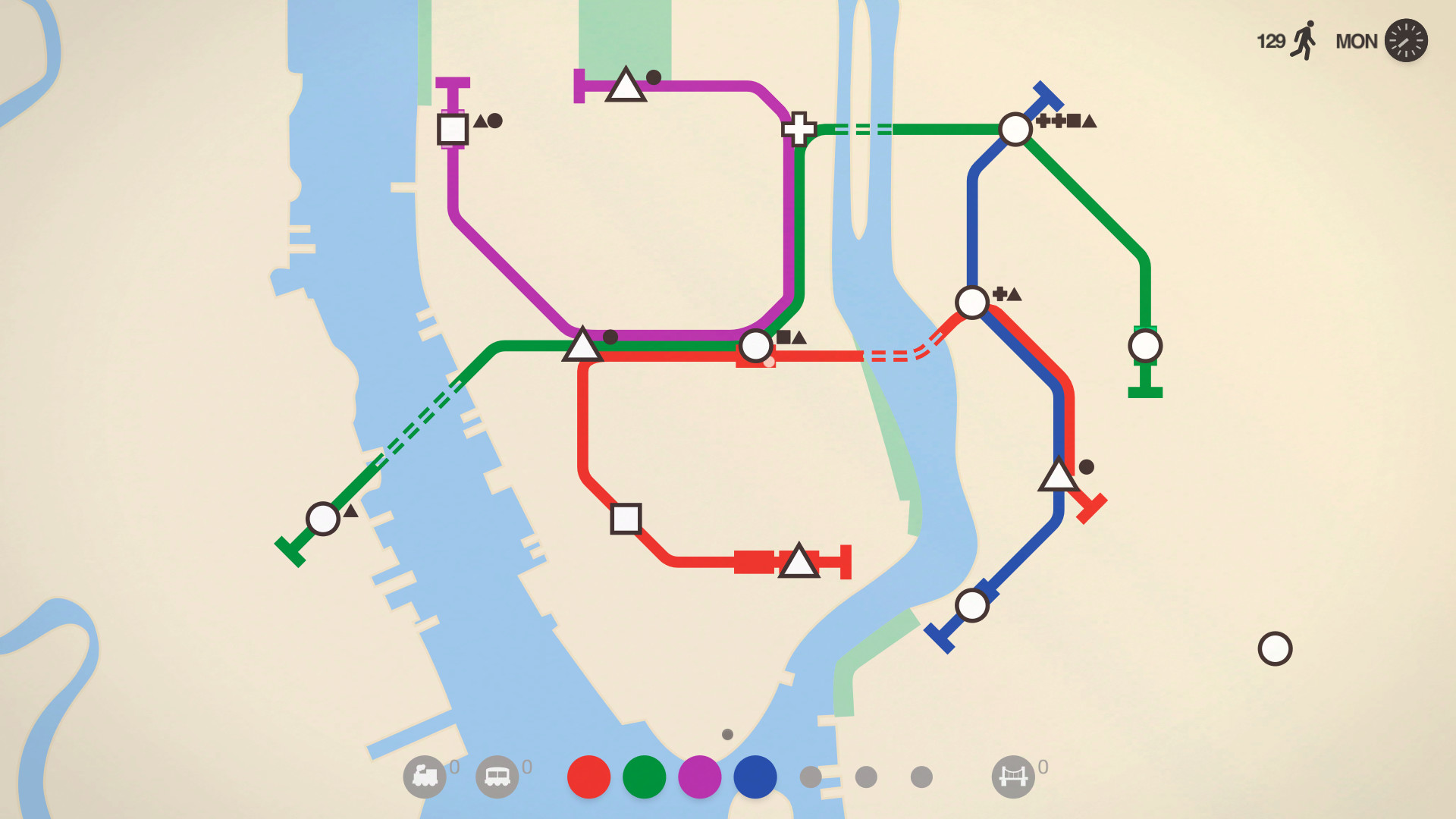
Mini Metro presents a city as a few geometric stations beside a river. Drawing a line between them starts the network, and small passenger shapes soon indicate where each traveler wants to go. The first minute feels almost effortless. Then a new station appears beyond an existing route, a rare shape attracts traffic from every direction and one crowded platform begins to pulse. The puzzle is continuous: there is no separate construction phase where every answer can be perfected. Each line is a temporary response to a city that keeps changing. Success depends on building a network that can absorb the next surprise, not merely clearing the passengers already visible.
Simple lines produce complex transfers
Passengers choose routes through the diagram, including transfers where lines meet. That means station order matters as much as direct distance. A central interchange can make the network efficient, but concentrating every route on one platform creates a dangerous point of failure. Loops distribute movement differently from straight lines, and a long branch may spend too much time carrying nearly empty carriages past common shapes. The game never asks the player to set individual schedules. Instead, complexity emerges from topology: which stations share a color, where uncommon destinations sit and how many alternative paths remain when traffic rises. Rearranging one segment can quietly improve several journeys at once.
Weekly upgrades define the strategy
At regular intervals, the city grants a locomotive and a choice between scarce resources such as another line, a carriage, an interchange or a bridge. These decisions give structure to the run. A new line may rescue an isolated district, while a carriage adds capacity to a route that is already well designed. Bridges are unexciting until water blocks expansion, and then their absence can end an otherwise healthy network. Because the correct choice depends on the current map, upgrades resist a universal priority list. Strong players read what kind of failure is approaching and buy time against it, accepting that solving today's crowd may leave a different weakness for tomorrow.
Minimal graphics carry dense information
The visual language borrows the clarity of transit diagrams. Lines have distinct colors, stations use simple shapes and passengers repeat those destination symbols at a smaller scale. Crowding is shown through accumulation and a visible warning ring, so urgency can be understood without opening a statistics panel. Animation remains restrained enough that the network is readable while trains cross and stations appear. Sound reinforces the map with quiet pulses and percussive movement rather than a dramatic score. This precision is not merely aesthetic. It lets the player scan a complicated city quickly, notice where triangles are collecting and adjust a route before a platform reaches its limit.
Different cities change familiar rules
Maps based on real cities vary their rivers, coastlines and special conditions, producing distinct network problems without abandoning the core notation. A broad river makes bridge allocation central; islands force careful crossings; dense growth can make short loops more useful than ambitious radial lines. These differences provide replay value because habits that work in one city may fail in another. Daily and challenge structures add fixed conditions for comparison, but the most compelling competition is often against personal understanding. A failed network usually leaves a readable lesson: too many lines crossed one hub, a remote station consumed travel time, or a carriage was added after capacity had already become unrecoverable.
When elegant control meets unavoidable pressure
The interface makes route editing easy, yet late-game changes can be disruptive because trains and passengers need time to adapt. A sensible redesign may briefly worsen congestion, and the game does not pause the city while the player experiments. Random station placement can also create awkward situations that feel harsher than earlier decisions deserve. These are part of the improvisational challenge, although they may frustrate players looking for a perfectly solvable logic puzzle. Every endless run eventually collapses, so the goal is resilience and score rather than permanent equilibrium. Accepting that premise turns failure from a verdict into a diagram of where the system finally exceeded its design.
Who should take control of the lines
Mini Metro is ideal for players who enjoy managing flows, simplifying complex information and revising a plan under gentle real-time pressure. Its controls are approachable, sessions fit comfortably into a break and the abstract presentation avoids unnecessary management detail. Beneath that accessibility is a demanding network game where transfer design, resource timing and geographic constraints support long-term improvement. Players wanting a traditional campaign or a city they can preserve indefinitely may find its inevitable failure impersonal. For anyone fascinated by maps and systems, however, few games turn such a small set of marks into so many clear, consequential decisions.