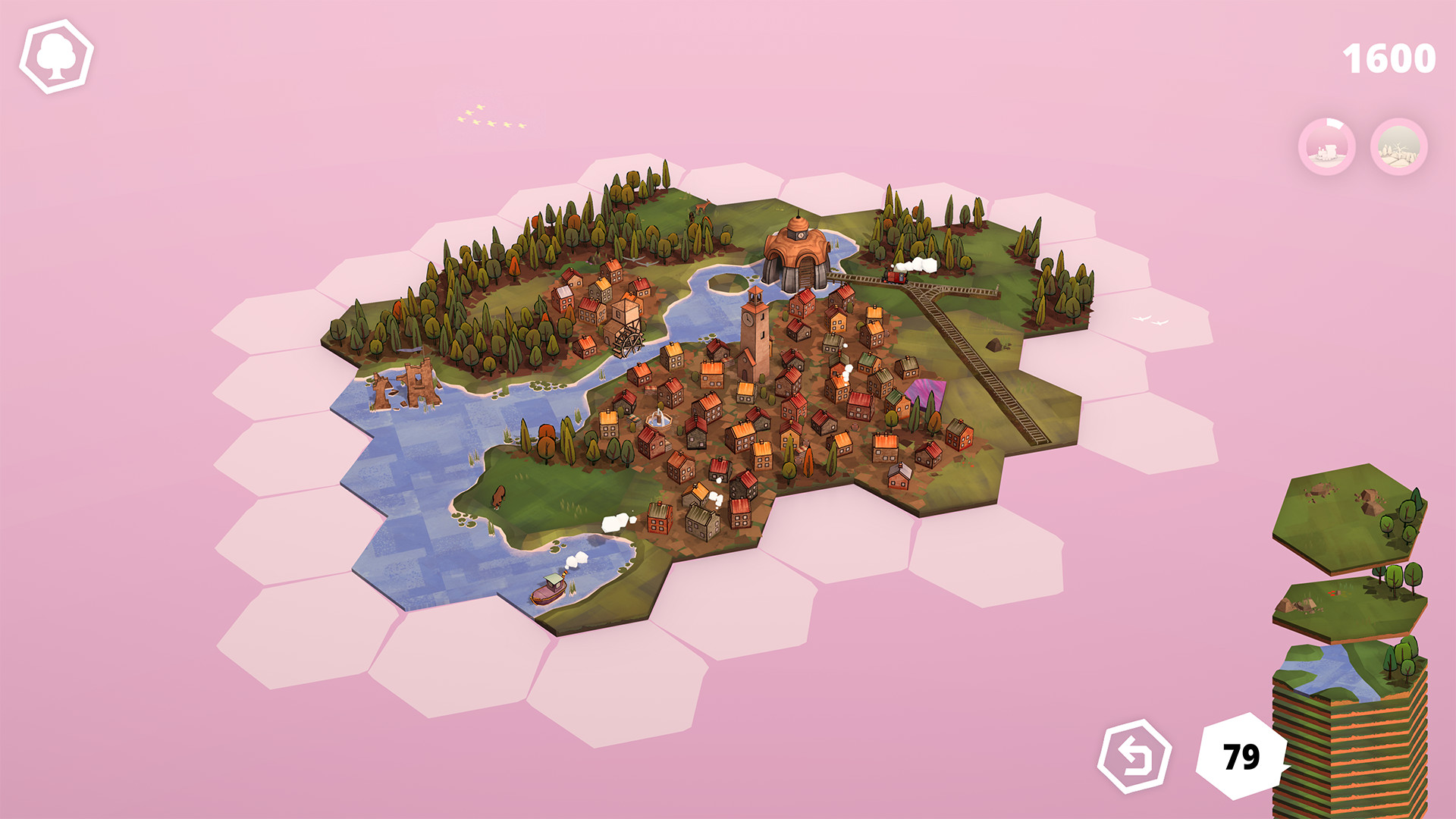
Compact islands turn city building into a spatial score puzzle where every mill, mansion and circus reshapes the value of nearby land.
- Format
- Spatial city-building puzzle
- Pace
- Relaxed with finite space
- Session
- 15-40 minutes
- Best for
- Players who enjoy compact optimization
A city builder reduced to placement decisions
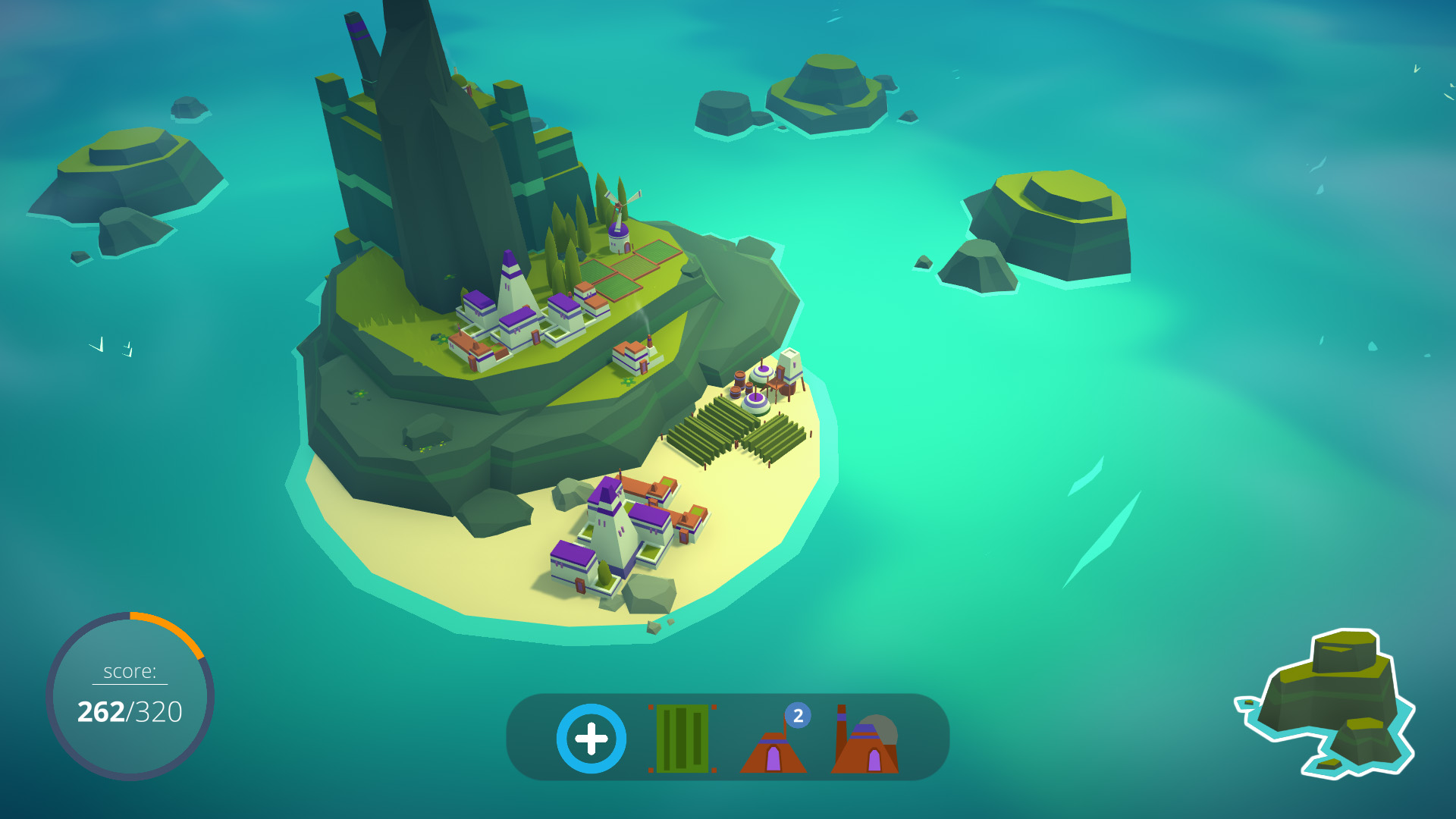
ISLANDERS removes roads, budgets, worker schedules and production chains from the city-building formula. The player receives a small group of structures and places them on a procedurally shaped island. Each building previews a score based on nearby features: a lumberjack prefers trees, a mansion values certain civic neighbors and an industrial site may penalize homes. Reaching score thresholds unlocks another pack and eventually a new island. The result is not a simulation of municipal growth but a focused spatial puzzle using the visual language of a settlement. Every placement asks how much value can be extracted now without consuming the terrain a later building may need more urgently.
Positive and negative space both have value
Buildings score through proximity, so the gaps between them are active resources. A tight cluster can multiply a synergy, but careless crowding may eliminate the only flat patch large enough for an awkward structure. Coastlines, cliffs and plateaus restrict footprints while also creating opportunities for specialized buildings. Good play therefore alternates between concentration and reservation. The player wants related structures close enough to interact, yet must imagine the silhouettes that have not appeared. Rotation and preview make experimentation clear before commitment. Once placed, however, a building stays, giving each attractive composition an underlying history of compromises that cannot be polished away after the island grows crowded.
Building packs create readable strategic pivots
New construction arrives in themed packs rather than as a complete catalog. Choosing between options introduces a light draft: one pack may strengthen an existing industrial cluster, while another opens a civic plan that needs untouched ground. The score target prevents purely decorative expansion, but there is rarely one mandatory answer. A modest placement can be worthwhile if it preserves a stronger future combination. This makes the game welcoming without making it empty. Numbers appear directly around the preview, so the consequence of moving a building is visible immediately. Improvement comes from understanding why a location scores well and recognizing when a locally impressive total creates a globally cramped island.
The miniature aesthetic supports the puzzle
Low-poly buildings, soft colors and tiny environmental details make each settlement pleasant to inspect after it is finished. The style clearly separates terrain levels and building footprints, which is crucial when usable space becomes scarce. Camera controls allow the island to be rotated so that hidden slopes and narrow ledges can be judged before a decision. There is little interface chrome beyond the current pack, score and placement preview. That restraint maintains the illusion of arranging a physical model while still exposing exact numerical feedback. The final city often looks organic because scoring encourages relationships rather than a strict grid, giving optimization an appealing visual result instead of reducing the island to a spreadsheet.
Progression keeps failure light
If a player reaches the required totals, new islands introduce different shapes, biomes and amounts of buildable land. Failure ends the sequence, but restarting is quick and early construction remains short enough to encourage another attempt. The broader high score links individual islands into a run, creating pressure to avoid waste without attaching a heavy campaign penalty. This structure suits the game's relaxed identity. A poor placement matters, yet it does not require reloading a long save or repairing an economy. The next pack may compensate, and the next run will offer a different geography. Progress is measured in improved spatial judgment as much as in unlocked scenery.
Simplicity places a ceiling on variety
The compact rules are also the main limitation. Buildings do not develop behaviors after placement, citizens do not create needs and a successful city does not become a living simulation. Once the core proximity relationships are familiar, later runs rely on island shape and pack order to create novelty. Some players will miss the ability to move a mistaken structure or continue decorating after score pressure ends. The numerical preview can also tempt optimization so strongly that visual creativity becomes secondary. ISLANDERS works best when approached as a score puzzle with city-building flavor, not as a replacement for a detailed sandbox where one settlement can evolve for dozens of hours.
Who should settle these islands
ISLANDERS is an inviting match for players who enjoy spatial efficiency, small strategic choices and the satisfaction of a dense miniature town. It delivers the visual pleasure of city building without administrative overhead, making a full session possible in the time another game might spend on a tutorial. Score chasers can study pack choices and adjacency, while casual builders can appreciate the evolving composition and move on when an island is complete. Those seeking economic simulation, long-term inhabitants or unrestricted decoration should choose a broader builder. For focused puzzle play, the balance of legible numbers, finite terrain and attractive results gives every small structure a meaningful place.