Movable words let each compact level rewrite its own rules, turning grammar into objects and assumptions into puzzle pieces.
- Format
- Rule-rewriting logic puzzle
- Pace
- Experimental and demanding
- Session
- 10-40 minutes
- Best for
- Players who challenge assumptions
The rules are objects inside the room
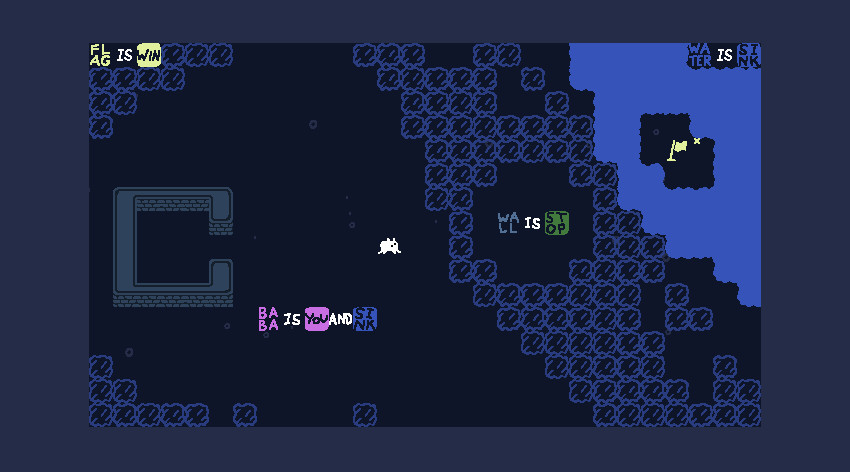
Baba Is You places short statements directly on the puzzle grid. Word blocks such as BABA IS YOU, WALL IS STOP or FLAG IS WIN define how the level currently behaves. Because those words can often be pushed, the rules are not a fixed explanation outside play; they are the primary materials of play. Breaking WALL IS STOP may let the character walk through barriers, while changing which noun is YOU transfers control to another object. The first levels teach this idea with gentle surprises, then steadily expose how radical it is. Solving requires asking not only how to reach the goal, but which parts of the apparent world need to remain true.
Grammar becomes a precise mechanical language
The vocabulary is small and consistent. Nouns identify objects, properties change behavior, and connecting words build statements along horizontal or vertical lines. This clarity allows complex interactions to emerge without lengthy instructions. A sentence can share a word with another sentence, making one push alter several rules at once. Properties may stack, objects may transform and a rule that creates victory can also remove the only controllable character. The language behaves more like a circuit than ordinary prose, yet it remains readable at a glance. Strong solutions come from understanding the grammatical structure, locating which word has freedom to move and predicting every rule that will exist after the push.
Undo makes bold experiments practical
Most mistakes can be reversed one move at a time, so dangerous ideas are inexpensive to test. That feature is essential because many breakthroughs begin as questions that sound destructive: what happens if the goal stops being WIN, if the player ceases to be BABA, or if water becomes something else entirely? Instant undo turns those questions into a working method. Restart is equally quick when an experiment changes too much. The game encourages a laboratory mindset where failure produces information rather than lost progress. Instead of planning every push from the starting state, players can manipulate one sentence, observe the new world and work backward from the possibilities that appear.
Simple art protects logical readability
Objects use loose pixel drawings and distinct colors, while word tiles remain crisp enough to scan across the entire room. Animation adds personality without making position ambiguous. This modest presentation leaves the rules visually dominant, which is appropriate for a game where a single block can redefine every wall. Sound effects confirm movement, transformation and success with economical cues. The map between levels also communicates optional branches and broader progression without burying the player in menus. The style may appear rough beside polished illustrative puzzle games, but its consistency is functional. Players can distinguish noun from object, rule from decoration and active statement from broken phrase even when a late puzzle contains many overlapping clauses.
Difficulty grows through conceptual traps
Later puzzles are difficult not because they demand faster input, but because they exploit assumptions learned from ordinary games and from Baba Is You itself. A familiar property may need to serve a completely different purpose, or the apparent goal may be a distraction from constructing a new one. Levels often have compact solutions that feel obvious only after the central idea is seen. The overworld provides branches, allowing a stuck player to explore elsewhere rather than ending the session at one wall. Even so, progress can become demanding. The game expects careful reasoning about state, space and language, and there are moments when leaving a puzzle overnight is more productive than repeating the same push sequence.
Brilliance does not guarantee a smooth pace
The inventive rules create memorable discoveries, but they can also produce severe difficulty spikes. Knowing all available words does not always reveal which conceptual leap a level wants, and the minimalist feedback cannot explain a misconception without giving away the answer. Players who dislike abstract experimentation may feel that they are guessing at the designer's trick. Moving blocks through narrow spaces can also require careful ordering after the solution is understood, adding logistical cleanup to a conceptual victory. Undo limits the cost, but not the mental fatigue. Baba Is You is most rewarding in measured sessions where a few puzzles can be considered deeply rather than rushed as a continuous campaign.
Who should rewrite the world
This is a landmark choice for players who love pure logic, surprising systems and the moment when an impossible room becomes solvable through a changed premise. Its controls are simple enough for almost anyone to begin, but the later reasoning is substantially tougher than the friendly art suggests. It is not ideal for players seeking a gentle sequence of obvious wins or a story-led adventure. For patient solvers, the combination of movable language, reliable undo and carefully staged escalation supports an enormous range of ideas from a small rule set. Baba Is You repeatedly demonstrates that the most interesting object in a puzzle can be the sentence explaining how the puzzle works.